🌙 Before you begin how heavy does the fear of disappointing feel right now?
0 = light · 10 = overwhelming
5/10The Fear of Disappointing Everyone
As you're reading, what's true for you?
Anonymous · real-time counts

Do you ever get that feeling? The one where you're mentally scanning a conversation you had hours ago, wondering if your tone was off? Or the quiet panic when your phone buzzes late at night, convinced someone is upset with you?
It's more than just being a "people-pleaser." It's a deeper hum of anxiety, a feeling of being responsible for the emotional weather of everyone around you. It's living under a sky full of invisible expectations, and it's exhausting.
From someone who's carried this weight too: I've spent years helping people untangle this exact fear. And yes, I've had to learn these lessons in my own life. This guide comes from both professional training and personal experience the kind you can't get from textbooks.
1. So, What Does This Really Feel Like?
It's not just about being nice. It's a specific kind of quiet fear. It's the knot in your stomach when you have to say no. It's the guilt that shows up even when you've done nothing wrong. It's the exhaustion that follows a day where you did everything for everyone else and nothing for yourself. Psychologist Harriet Braiker, who extensively studied this pattern, described people-pleasing as an addiction to approval, where individuals become trapped in a cycle of seeking external validation at the expense of their own well-being [1]. Research from Cleveland Clinic indicates that about 12% of adults in the U.S. experience a specific phobia at some point in their lives, and while the fear of disappointing others is not a clinical diagnosis, it shares similar patterns of anxiety and avoidance [9].
If you often feel drained after trying to meet everyone's expectations, you might relate to The Psychology of Shame and Fearing Being a Burden it explores the deep connection between shame and people-pleasing.
Pause here. Just for a moment.
2. The Unspoken Rulebook: Where Do These Invisible Expectations Come From?
Nobody tacks a list on your door. They're silent agreements we make with ourselves. As psychologist Dr. Alison Cook explains, in order to meet your own neglected needs, you must first face the fear of disappointing those around you [3]. This fear often takes root in childhood. As therapist Meg Josephson observes, "fawning" a term for compulsive people-pleasing is frequently a survival response developed to maintain safety by appeasing others [8]. These internal rules sound like:
"We can't practice compassion with other people if we can't treat ourselves kindly."
If this feels tied to deeper patterns of always putting others first, you might find How to Set Healthy Boundaries Without Guilt helpful it offers practical scripts for protecting your energy.
3. A Little Story About How We Got Here
Maybe, as a child, love felt conditional. Praise came with straight A's. A parent's smile appeared when you were quiet and "easy." You learned, deep in your bones, that your job was to keep the emotional peace. This pattern is a common adaptation to unstable or conditional caregiving environments. As psychotherapist Kate O'Brien (LCAT) notes, people-pleasing can be a natural outcome when you've been shamed for your choices or for who you are. Recognizing this pattern isn't about self-blame, it's about understanding where it came from [2].
Research on attachment theory supports this: individuals with anxious attachment styles, who often fear abandonment, are significantly more likely to develop people-pleasing behaviors as a way to secure their relationships and avoid rejection [15]. If you grew up in a home that felt unstable with a parent who was sick, struggling, or emotionally unpredictable you might have learned to become a tiny detective, constantly scanning for danger and trying to manage everyone's moods just to feel safe.
This wasn't a character flaw. It was a brilliant adaptation to keep yourself safe.
The problem is, our brains don't always update the software. The child who learned to survive by pleasing others becomes the adult who is terrified of disappointing them. Physician Gabor Maté, who writes extensively on trauma and addiction, explains that many of our most ingrained coping mechanisms are responses to early pain they are adaptations that once served a purpose but later become limiting [4].
A letter from your future self
"Dear you, still worried about letting people down,
The freedom you're looking for doesn't come from pleasing everyone it comes from realizing you never could. And that's okay. The people who matter will adapt. The ones who don't? They were never yours to carry.
I'm writing from the other side. The weight you feel right now? It becomes the very thing that teaches you who deserves your presence. Keep going. You're closer than you think."
4. A Gentle Checklist: Do You Recognize Yourself Here?
This isn't a test you can fail. It's just a way to see if this invisible weight feels familiar. Check what resonates, it's just for you.
Signs the weight might feel familiar
5. The Real Toll: What This Fear Quietly Steals
Your Inner Voice Goes Mute
You spend so much time listening to what everyone else wants, you eventually forget what you actually want. What's your favorite movie? What do you want for dinner? The answers get harder to find. This loss of self is a hallmark of the people-pleasing pattern, where external validation gradually replaces internal guidance [5].
The Slow Burn of Resentment
The more you give to avoid disappointing people, the more you start to resent them for not seeing how much you're sacrificing. You feel invisible, even though you've made it your mission to be everything for everyone. Brené Brown's research highlights that a lack of clear boundaries inevitably leads to resentment, as we give beyond our capacity and then feel angry at those we've overextended for [6].
Your Body Keeps the Score
When your heart stays silent, your body often speaks up. Tension headaches, tight shoulders, churning stomach, or exhaustion that sleep can't fix. Your body is trying to get your attention. The chronic stress of hyper-vigilance and emotional suppression can manifest physically, as the body bears the weight of unexpressed needs and unprocessed emotions [4].
"The question is not 'why the addiction?' but 'why the pain?'"
6. Why Letting Go Feels So Impossible
Because disappointing someone doesn't just feel like a small mistake. It feels like:
For people with deep empathy people who feel things intensely setting a boundary can feel like an act of betrayal. Your brain has wired "keeping the peace" with "staying safe." So trying to break that pattern feels terrifying. It feels like you're stepping off a cliff. As psychologist Dr. Lisa Linardatos writes, guilt isn't all bad it can tell us when we're acting out of alignment with our values. However, when guilt becomes overwhelming each time you consider setting a boundary, it's worth asking whether that level of guilt truly fits the situation [7]. This intense fear of negative evaluation often has roots in a deep-seated fear of rejection, which can feel existential to those who have learned that their safety depends on others' approval [15].
What's your relationship with disappointing others?
Anonymous · Only you and this moment know
7. Let's Redefine What "Good" Really Means
Responsibility is...
Over-responsibility is...
You are 100% responsible for your behavior.
You are 0% responsible for someone else's
reaction to your healthy boundaries.
8. The Relationship Paradox
This is the part that hurts the most. The very thing you're doing to protect your relationships trying not to disappoint anyone is the thing that slowly erodes them. It creates distance because people can't truly know the real you. It builds a wall of silent resentment. Psychologist Gina Barreca, Ph.D., writes that being let down by others while painful in the moment is often less haunting than the weight of knowing we've disappointed someone, even unintentionally [10]. Moreover, unrealistic expectations of others often part of the people-pleasing dynamic can lead to dissatisfaction when real relationships fail to live up to idealized fantasies [12].
A gentle truth:
Healthy relationships can survive disappointment. In fact, they grow because of it. When you show up as a whole, honest person someone who has limits you give the other person permission to have theirs, too.
Unhealthy relationships depend on your compliance. If a connection can only survive if you're constantly shrinking, was it really a connection at all?
Try a Micro-Boundary
Let's practice with a common scenario. A friend asks you to help them move this weekend. You're exhausted and need rest.
This protects their feelings, but leaves you empty. Notice the resentment that quietly builds underneath.
You said no that's brave! But the over-explaining comes from fear. A simple "no" is enough. You don't owe a defense.
This is a clean, kind boundary. You honored yourself without over-explaining. Notice how it feels to read it.
9. Gentle First Steps Back to Yourself
As therapist Nick Wignall explains, overcoming an excessive fear of disappointing others requires a willingness to actually do the thing that might lead to someone feeling disappointed [11]. Here's where to start:
1. Just Notice the Feeling
Next time guilt washes over you for saying no, don't fight it. Just say: "Ah, there's that old guilt. Hello. I see you, but I don't have to do what you say today." This practice of mindful awareness allows you to observe the feeling without being controlled by it.
2. Practice a "Micro-Boundary"
Start so small it feels silly. Instead of automatic "yes," try: "Let me check and get back to you." or "That doesn't work for me." These small shifts can help you build the "boundary muscle" over time.
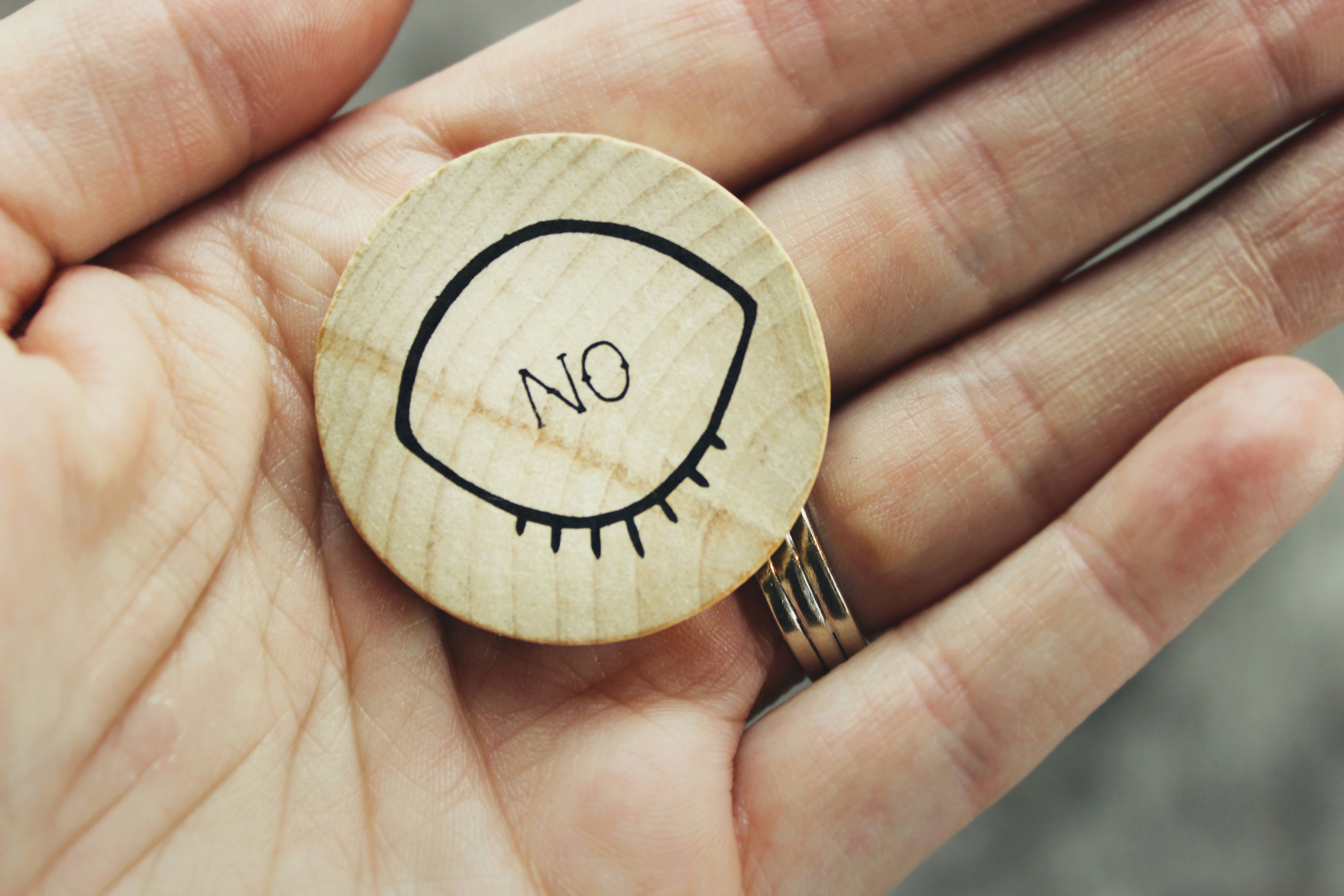
3. Let "No" Be a Complete Sentence
You don't owe anyone a 10-minute explanation. A kind "no" is a full answer. You're not a product on a shelf. This is a key step in moving away from over-explaining, a common behavior in people-pleasing [5].
4. Give Yourself Permission to Disappoint
Say it out loud: "It is okay if someone is disappointed in me." Their disappointment is theirs to process. It does not define your worth. Dr. Alison Cook reminds us that while it's never someone else's job to manage your feelings, it's also never acceptable for a disappointed person to become abusive. If someone's reaction turns toxic, you have every right to step away [3]. Remember, as Brené Brown's work emphasizes, we cannot practice compassion with others if we don't treat ourselves kindly first [6].
Before you go...
How did this article make you feel? Your small reaction helps this space grow with more meaningful stories. 💛
10. Questions to Sit With
- 🌿 Who was the first person you remember trying so hard to keep happy? What did you learn from them about what you "should" be?
- 🌿 If you took a 24-hour break from managing anyone else's feelings, what's the first thing you would do?
- 🌿 Think of the people you're most afraid of disappointing. Do they love you, or do they love the version of you that never says no?
- 🌿 What is one small thing you could do today, just for you, that might disappoint someone else?
11. The Honest Truth You Need to Hear
You are going to disappoint people in your life. That is not a prediction of failure; it's a fact of being a person with your own mind, your own path, and your own needs. You will let people down, and people will let you down. Dr. Eva Serber, PhD, notes that therapy can help you explore where this fear comes from whether from past experiences or ingrained patterns and that understanding its root is the first step toward freeing yourself [13]. The goal isn't to never disappoint anyone it's to build a life where you can hold both your own needs and the disappointment of others with grace and resilience.
And that's okay. It has to be okay.
Because you are not on this earth to be a supporting character in everyone else's story. You are not here to be small, to be quiet, to be easy. You are here to live your own, honest, messy, wonderful life.
"The curious paradox is that when I accept myself just as I am, then I can change."
12. A Final Thought, From Me to You
Living under the weight of invisible expectations slowly pulls you away from the person you actually are. It's a slow drift, and one day you wake up and feel like a stranger to yourself.
Freedom from this doesn't start with a dramatic rebellion. It doesn't start with burning bridges.
It starts with one quiet, honest sentence, whispered to yourself in a moment of courage:
"I cannot carry this anymore."
And here's the part you might not believe yet: The people who truly belong in your life the ones who love you, not the performance they won't leave. They might need a moment to adjust. But they will stay.
And for the first time in a long time, you'll have the space to breathe.
About this article: This educational guide was written by Shobini Padmanapan, an independent wellness writer and editorial researcher at SoulSpace. It explores the fear of disappointing others, people-pleasing patterns, attachment theory, and healthy boundary-setting using accessible psychology concepts and reflective frameworks.
Scope & Boundaries: This content does not constitute clinical mental health advice, psychological diagnosis, or medical treatment. If you are experiencing distress, please consult a qualified healthcare or mental health professional.
Author profile: soulspaceguide.com/authors/shobini-padmanapan
Answers to Questions You Might Hold
Found this helpful? Share it with someone who needs it.
Written by Shobini Padmanapan · SoulSpace
✨ After reading how heavy does the fear feel now?
5/10Your Disappointment Cheat Sheet
- You are 0% responsible for others' reactions to your healthy boundaries
- Kindness ≠ people-pleasing one feels light, the other heavy
- "No" is a complete sentence you don't owe a 10-minute explanation
- Start with micro-boundaries: "Let me check and get back to you"
- Disappointment is survivable and healthy relationships grow through it
- Your worth is not tied to how much you do for others
References & Further Reading
- Braiker, H. B. (2001). The disease to please: Curing the people-pleasing syndrome. McGraw-Hill.
- O'Brien, K. (n.d.). The fear of disappointment: Why you're terrified of letting others down. Kate O'Brien LCAT. https://www.kateobrienlcat.com/blog/fear-disappointment
- Cook, A. (n.d.). How to get over your fear of disappointing others. Dr. Alison Cook. https://www.dralisoncook.com/blog/how-to-get-over-your-fear-of-disappointing-others
- Maté, G. (2008). In the realm of hungry ghosts: Close encounters with addiction. North Atlantic Books.
- Braiker, H. B. (2001). The disease to please: Curing the people-pleasing syndrome. McGraw-Hill.
- Brown, B. (2010). The gifts of imperfection: Let go of who you think you're supposed to be and embrace who you are. Hazelden Publishing.
- Linardatos, L. (2023, February 10). Disappointing others: It has to happen sometimes. Connect Psychology. https://connectepsychology.com/en/2023/02/10/disappointing-others-it-has-to-happen-sometimes/
- Josephson, M. (2025). Are you mad at me? The fear of disappointing others and finding freedom in being yourself. [Summary]. IRB.
- Cleveland Clinic. (2021, October 22). Atelophobia (fear of imperfection). Cleveland Clinic Health Library. https://my.clevelandclinic.org/health/diseases/21932-atelophobia-fear-of-imperfection
- Barreca, G. (2020, March 25). Fear of disappointing others: How to cope and what to learn. Psychology Today. https://www.psychologytoday.com/us/blog/snow-white-doesnt-live-here-anymore/202003/fear-disappointing-others-how-cope-and-what-learn
- Wignall, N. (2021, October 10). How to overcome your fear of disappointing others. Nick Wignall. https://nickwignall.com/fear-of-disappointing-others/
- Lucchi Basili, L., & Sacco, P. L. (2016). Charming princes or princesses are uncommon... In Behavioral Sciences, 6(4), 24. https://doi.org/10.3390/bs6040024
- Serber, E. (2024, June 4). Breaking free from the fear of disappointing others: Finding confidence in your true self. Dr. Eva Serber, PhD, LLC. https://evaserber.com/breaking-free-from-the-fear-of-disappointing-others-finding-confidence-in-your-true-self/
- Fitriani, E. N. (2026). Why being nice is ruining your life more than you think. Academia.edu. https://www.academia.edu/168306126/Why_Being_Nice_Ruining_Your_Life_More_Than_You_Think
- Mikulincer, M., & Shaver, P. R. (2016). Attachment in adulthood: Structure, dynamics, and change (2nd ed.). Guilford Press.
- Walker, P. (2013). Complex PTSD: From surviving to thriving. Azure Coyote Publishing. [Definitive source on the "fawn" trauma response.]
- American Psychological Association. (2023). Boundaries and healthy relationships: Resources for emotional well-being. APA. https://www.apa.org/topics/relationships
Related Articles from SoulSpace
For late bloomers finding their path
How to Cope With Feeling Behind in LifeRelease timeline anxiety
Rebuilding Self-Trust After BetrayalHealing after broken trust
Feeling Lonely in Social SettingsUnderstanding emotional isolation
How to Stop Overthinking at NightCBT strategies for racing thoughts
Childhood Parentification and Early MaturityWhen you grew up too fast
You were never meant to carry it all.
The weight you've been holding it was never yours to bear. Some of it was handed down. Some of it you picked up along the way, mistaking it for love.
You can set it down now. Slowly, gently, one piece at a time.
Based on your reading: How to Set Healthy Boundaries Without Guilt Recommended for you
Join the Conversation
Article by Shobini Padmanapan · Independent Wellness Writer
Be the first to share your reflection.