How are you feeling right now?
Biting, Hitting, Pushing

As you're reading, what's true for you?
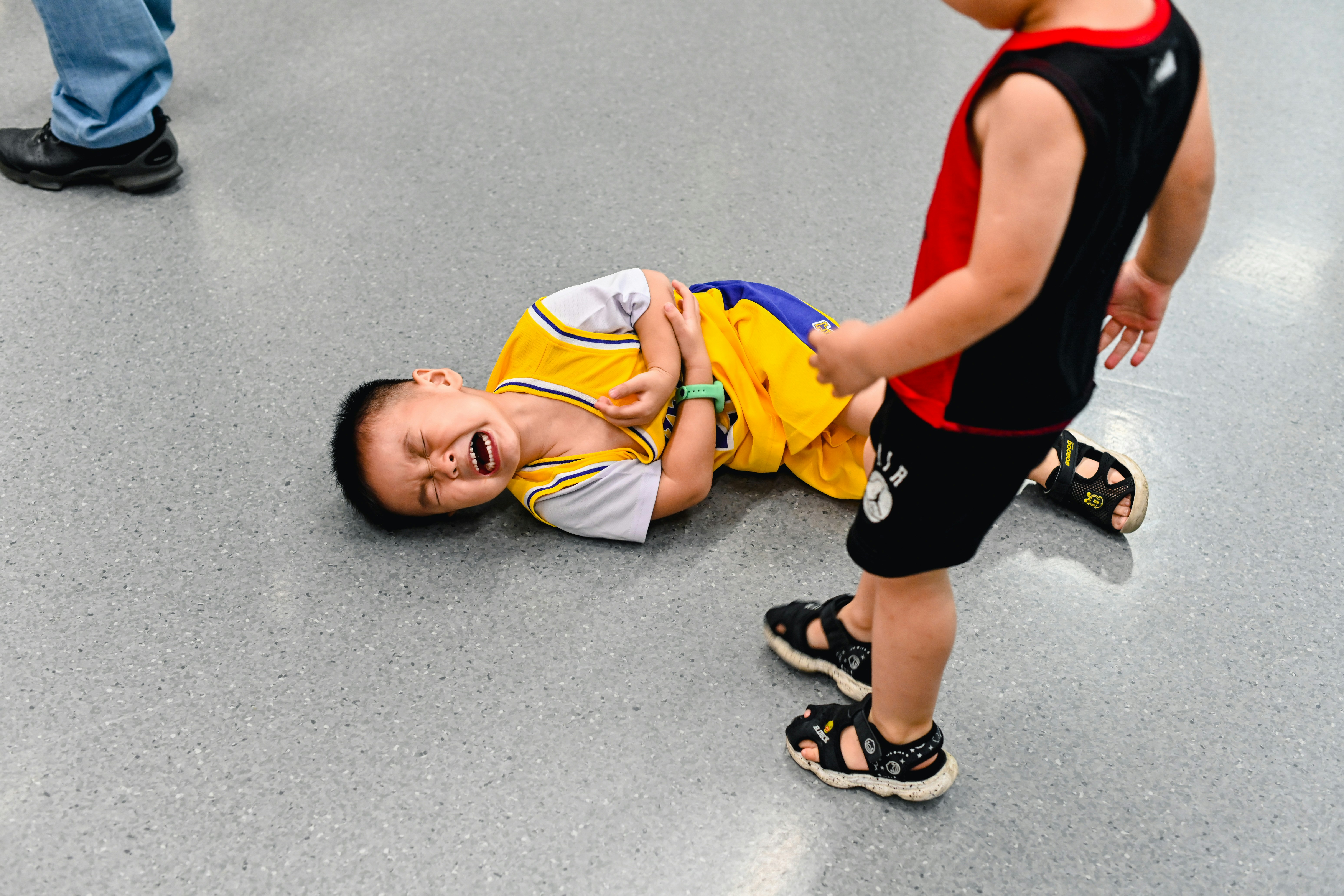
First, take a deep breath. You are not alone. That sweet little baby who used to coo has suddenly developed teeth, fists, and strong opinions about everything. One moment they're hugging you, the next they're biting your shoulder because you dared to cut their toast into triangles instead of squares. [1]
This is the "Me Do It" stage. And while it can be exhausting and embarrassing, it's also a completely normal (and actually important!) part of your toddler's development. [2]
"Imagine being in a foreign country where you don't speak the language, you have zero control over your schedule, and you feel every single emotion at 100% volume. That's life for a toddler. They aren't being 'bad'; they're having a hard time." [3]
What's really happening inside?
In the toddler years, young children haven't yet developed the self-control to stop themselves from acting on their impulses. Some children express frustration with their bodies more than others, but this doesn't mean they're making a conscious choice to be harmful. [4]
"Toddlers are not giving you a hard time. They are having a hard time."
Your in-the-moment action plan
Research shows that parents and caregivers must respond to aggressive behavior immediately. If you wait until later, your child might not remember what they did. Make sure your child understands the rule and the reason behind it: "We never hit people. Hitting hurts." [9]
Be the calm they can borrow
See their explosion as a cry for help, not an attack. Take a deep breath. Get to their eye level. Your calm says "I am in control, and you are safe." Calmly removing a child from the situation can be one of the best solutions. Be prepared that you may have to do it more than once for the lesson to stick. [10][11]
State the boundary clearly
"I won't let you hit. Hitting hurts people." Then separate the feeling from the action: "It's okay to be angry, but it's not okay to bite." Rather than giving your child attention only when they're misbehaving, aim to give them the most attention for positive behavior. [12][13]
Be their translator
"You are SO angry right now because she took your car. You wanted it." Giving them words is like giving a hungry person food. Help your toddler learn to use words instead of hitting. It's also perfectly acceptable to teach your toddler how to say a firm "No" instead of lashing out. [14][15]
Teach the "right" way
"Next time, if you're angry, we can stomp our feet like a dinosaur or squeeze my hand really hard." Some toddlers benefit from physical alternatives to aggression hitting a pillow, stomping feet, or doing an "angry dance." Heap praise on them when they tell you what they want, and be specific with it. [16][17]
Real moments, real responses
Pause. Breathe.
What's the hardest moment you've faced this week?
When to worry: a gentle reality check
Most children grow out of this phase by age 4 as their language and self-control develop. By the time your child is around age 7, physical expressions of aggression should taper off significantly. But trusting your gut is important. [21][22]
It might be time to check in with your pediatrician if:
- The aggression is very frequent or intense, happening multiple times a day for weeks [23]
- Your child is hurting themselves physically (like scratching their own arms) or causing injuries to others regularly [24]
- The behavior continues or gets worse past age 4, or they're removed from places like daycare because of it [25]
- Your child has trouble calming down, even with your support, or their outbursts are affecting daily functioning [26]
- You notice other concerns like significant speech delays, sensory sensitivities, or signs that might suggest ADHD, anxiety, or autism [27][28]
Asking for help isn't admitting failure. It's a sign that you're a proactive, caring parent. Start by talking with your pediatrician they can refer you to a mental health professional if needed. [29]
Understanding the root causes of aggression helps you respond more effectively. Learn more about Why Toddlers Have Meltdown Reactions Over Small Things and how to navigate those challenging moments.
What about sensory sensitivities?
Many young children have sensory sensitivities meaning the way they touch, feel, and experience the world differs from how you experience it. Some children are sensory-sensitive and might feel crowded or overwhelmed by touch, leading them to hit or push as a reaction. Others actually need more sensory input and may hit, tackle, or squeeze as a way to explore sensations. For these children, big hugs, deep-pressure massages, or an Occupational Therapy evaluation might be helpful. [30]

For some children, the world feels overwhelming sensory sensitivities can trigger big reactions
The feelings we don't name at playgroup
"When your kid bites another kid, your face burns with embarrassment. You want to disappear."
You might feel judged. You might wonder if you're a bad parent. Please hear this: Your child's behavior is not a reflection of your parenting. It's a reflection of their brain development. Sometimes a parent's own past experience like growing up with very strict rules influences how they react to their child's behavior. Being aware of these connections helps you respond more effectively. [31]
That mom giving you the side-eye? Her kid probably bit someone last week. This is the messy, humbling, beautiful reality of raising tiny humans. Be kind to yourself. [32]
A Letter From Your Future Self
Dear parent,
I'm writing this from the other side. I know you're in the thick of it the biting, the hitting, the public meltdowns that make you want to disappear.
Here's what I want you to know: Every time you knelt down, stayed calm, and said "I won't let you hit," you were teaching something that will last forever. Every boundary you held with love was a brick in their emotional foundation.
The toddler who bites today will become a child who says "I'm angry" instead of swinging a fist. The little one who pushes at the playground will learn to say "My turn please." You're not failing. You're building. And building takes time.
Thank you for not giving up. Thank you for being the calm in their storm. You are the reason they'll learn to navigate their own storms someday.
With so much love,
You one year wiser, and so proud of
who you were becoming in these hard moments.
"Our toddlers are not giving us a hard time; they are having a hard time. Our job is to be the calm, steady anchor in their storm."
10 small shifts that prevent big explosions
Based on child development research, these daily practices can make a real difference: [33]
- Give your child your full attention put down your phone and really listen
- Snuggle frequently warm, close cuddle time throughout the day builds security
- Maintain predictable schedules for playing, sleeping, and eating
- Offer reasonable small choices "Do you want to put your shoes on yourself or with help?"
- Ensure three hours of active play daily especially outdoors when possible
- Create a harmonious environment children mimic what's happening around them
- Role-play different possibilities in calm moments, then reverse roles
- Create a "quiet corner" your child chooses to visit, not as punishment
- Teach breathing exercises "breathe in to the count of five, then breathe out like a dragon"
- Take good care of yourself you're the model for emotional regulation
For more guidance on nurturing emotional development, explore Teaching Toddlers to Label and Identify Feelings a practical guide for building emotional vocabulary.
Before you go...
How did this article stay with you? Your small reaction helps this space grow with more meaningful stories.
Before you go...
How did this article make you feel? Your small reaction helps this space grow with more meaningful stories. 💛
What's your honest truth today?
No judgment. No advice. Just space to let it out.
Anonymous · Only you and the universe know
About this article: This educational guide was written by Shobini Padmanapan, an independent wellness writer and editorial researcher at SoulSpace. It synthesizes publicly available research on toddler aggression, biting, hitting, and early emotional regulation.
Scope: Educational and informational only. Not clinical advice, diagnosis, or treatment.
Author profile: soulspaceguide.com/authors/shobini-padmanapan
Answers to questions you're afraid to ask
How do you feel now after reading?
Quick Reference Card
📄 Click to save or printFound this helpful? Share it with someone who needs it.
Written by Shobini Padmanapan · SoulSpace
References & Research Sources
- Robinson, G. (1991). Aggressive behavior in the pre-verbal child [Paper presentation]. Annual Meeting of the National Association for the Education of Young Children, Denver, CO, United States. https://eric.ed.gov/?id=ED341488
- Lorber, M. F., Del Vecchio, T., & Smith Slep, A. M. (2018). The development of individual physically aggressive behaviors from infancy to toddlerhood. Developmental Psychology, 54(4), 601–612. doi.org/10.1037/dev0000450
- Klein, T. (2014). How toddlers thrive: What parents can do today for children ages 2-5 to plant the seeds of lifelong success. Touchstone.
- Nærde, A., Ogden, T., Janson, H., & Zachrisson, H. D. (2014). Normative development of physical aggression from 8 to 26 months. Developmental Psychology, 50(6), 1710–1720. doi.org/10.1037/a0036324
- Edelman, B., & Del Vecchio, T. (2024). When crying turns to hitting: Examining maternal responses to negative affect. Infant Behavior and Development, 74, 101918. doi.org/10.1016/j.infbeh.2023.101918
- Frenkel, T. I., Aptaker Ben-Dori, S., & Atzaba-Poria, N. (2025). Individual differences in infants' expectations and preferences for responsive vs. unresponsive parent-puppets and their associations with early maternal behavior. Attachment & Human Development, 27(1), 1–21. doi.org/10.1080/14616734.2025.2562511
- Brazelton, T. B., & Sparrow, J. D. (2005). Mastering anger and aggression: The Brazelton way. Da Capo Press.
- Stover, C. S., Connell, C. M., Leve, L. D., Neiderhiser, J. M., Shaw, D. S., Scaramella, L. V., Conger, R., & Reiss, D. (2012). Fathering and mothering in the family system: Linking marital hostility and aggression in adopted toddlers. Journal of Child Psychology and Psychiatry, 53(4), 401–409. doi.org/10.1111/j.1469-7610.2011.02510.x
- Lansbury, J. (2014). No bad kids: Toddler discipline without shame. JLML Press.
- Siegel, D. J., & Bryson, T. P. (2011). The whole-brain child: 12 revolutionary strategies to nurture your child's developing mind. Delacorte Press.
Citations are provided for educational and commentary purposes under fair use. All sources remain the property of their respective authors and publishers. These references are offered as further reading to support the developmental concepts discussed in this article. Full citations include authors, publications, and dates where available.
This is hard. And you're doing it anyway.
The goal isn't a perfectly behaved toddler. That doesn't exist. The goal is to be their safe place, their calm guide, and their translator as they navigate this big, confusing world. [34]
And one day, sooner than you think, that little biter will look at you and say, "I'm sad because my tower fell down," instead of just knocking it over.
And you'll both know it was worth it.
You might also need...
Curated by Shobini Padmanapan
Continue Your Developmental Journey
Your Quick Guide to Toddler Aggression
Everything you need to know in 3 minutes
😤 Why They Bite, Hit & Push
💝 Your In-The-Moment Action Plan
🚫 What NOT To Say
🩺 When To Check In
💛 The Heart of It
Your toddler isn't attacking you they're communicating the only way they know how.
The goal isn't a perfectly behaved toddler. The goal is to be their safe place, their calm guide, and their translator as they navigate this big, confusing world.
One day, sooner than you think, that little biter will say "I'm sad" instead of swinging a fist.
Be the first to share your thoughts anonymously or with a name.