The Empathy Leap
Before reading: How alone or overwhelmed do you feel right now?
As you're reading, what's true for you?
Anonymous · real-time counts
One minute they're offering their favorite stuffie to a crying friend. The next, they're grabbing it back, shrieking "MINE!" like a tiny gargoyle. Welcome to the empathy leap where kids ricochet between angel and gremlin.
If you've ever wondered "Is my child a future philanthropist or a sociopath?" breathe. The answer is neither. They're just 4, and their brain is building the most complex social muscle we have.
1. The "Toddler Tyrant" phase is ending (slowly)
Why three-year-olds act like tiny dictators and why it's not personal
Three-year-olds run on a simple OS: "I want. I want NOW. Why can't I have it?" They genuinely believe that if they want the red cup, you magically know it and you're being difficult by handing them the blue one. This is called egocentrism, and it's not selfishness; it's a brain that hasn't yet built the "other people have minds too" circuitry. [1]
The shift starts with... you
When you say "I'm sad because you hit," and they stare blankly, they're not ignoring you they're processing. Repeat. Name feelings. One day, they'll surprise you.
"A child's ability to feel for another rests on first being felt by someone themselves."
Understanding how emotional development unfolds is key. Read Why Toddlers Have Meltdowns Over Small Things to understand the emotional foundation that empathy builds upon.
2. Decoding the great "Why?" epidemic
Not all why's are created equal
"Why is the sky blue?" (exhausting). "Why is that man yelling?" (gold). When your child asks about emotions they witness, they're building a Feelings Map. Research indicates that preschoolers are naturally wired to learn empathy through imitation and real-world experience. [6] When children observe adults expressing kindness, labeling emotions, or comforting others, they internalize those actions and begin to mirror them. [6]
Try this instead of shushing
Child: "Why is that girl scared of the dog?"
Old response:
"She's fine, let's go."
Empathy-building response:
"Great question! Maybe the dog is bigger than her. How could we
help her feel better?"
For more ways to build emotional intelligence, explore Teaching Toddlers to Label and Identify Feelings a practical guide for everyday moments.
3. Reading the room (literally)
Preschoolers are face detectives. They notice your tight shoulders, your real smile vs. your "I'm fine" smile. This is emotional recognition the foundation of social intelligence. According to Beyond Blue, children between ages 3 and 5 are actively learning to understand why emotions happen, express feelings with words, and identify how others might be feeling. [11] By helping children name their emotions "You look sad that your tower fell down" or "It made you happy when your friend shared that toy" parents give them the language to make sense of both their own feelings and those of others around them. [6]
Bedtime story hack
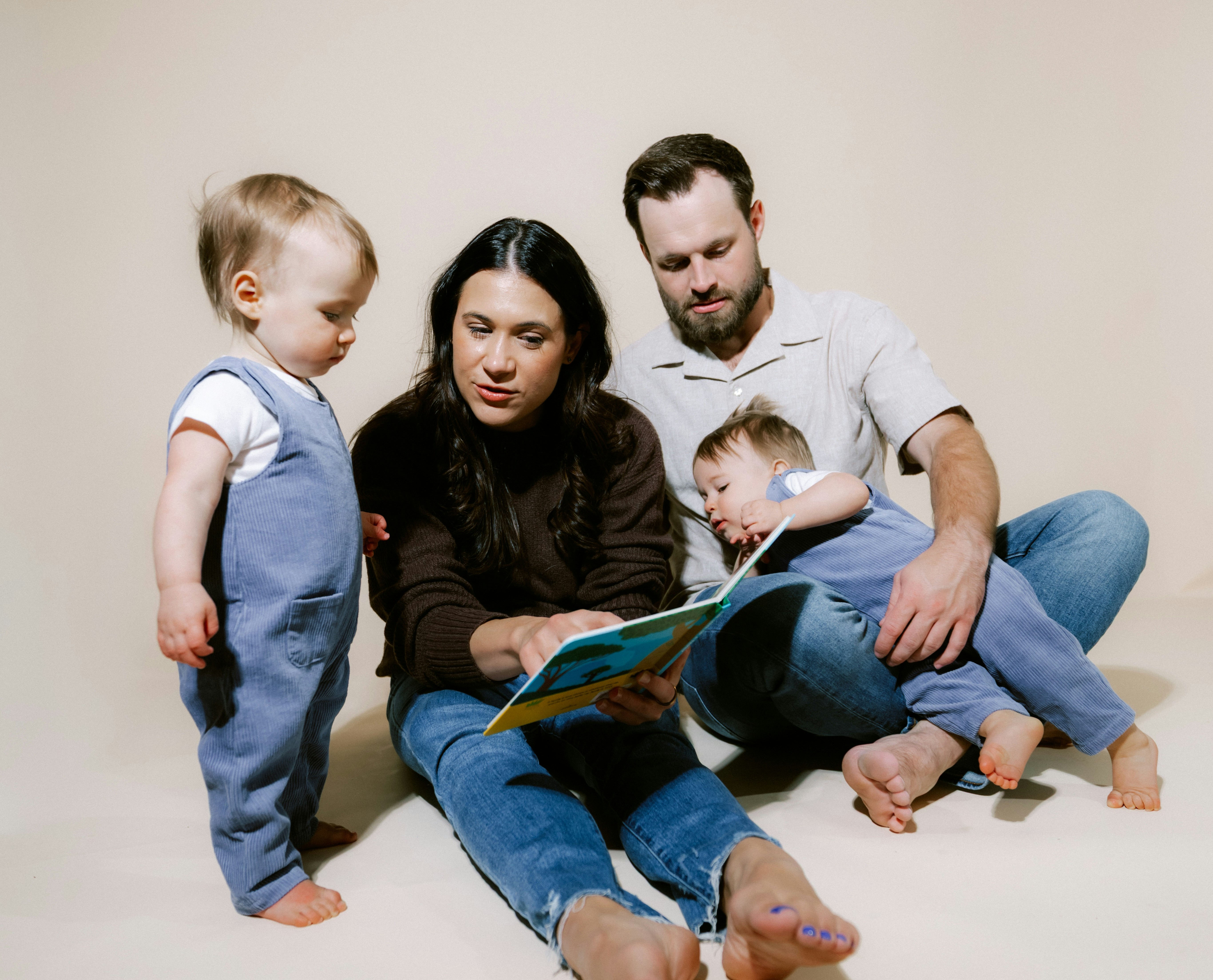
Pause on illustrations. Don't just read ask: "Look at that bear. How does he feel? Why is he making that face? What might happen next?" You're turning stories into empathy workouts. Studies have shown that using picture books to discuss emotions can significantly boost young children's empathy and prosocial behavior. [7]
Pause & notice
- When was the last time your child mirrored someone else's emotion?
- What face do you make when you're stressed? (they're watching)
- Try narrating feelings today: "I'm frustrated the toast burned. I'm going to breathe."
4. The joy & pain of parallel play becoming cooperative
Two three-year-olds digging side by side? Parallel play fine. But around 4–5, they actually want to play together. And that's where the wheels fall off. "You're not my friend anymore!" is the anthem of the empathy-in-progress child. The good news? Zero to Three notes that by age three, most children understand language well enough to handle simple explanations about rules and limits. [4] Pointing out how rules benefit your child helps them learn cause and effect: "When you share toys, it means that everybody gets a chance to play." [4] Natural consequences both positive and negative help children understand the impact of their choices. [4]
5. The first aid kit: when kids start to comfort
One day you stub your toe. Before you can even hop, a tiny hand pats your arm. They offer their lovey. This is the milestone: they're not just noticing, they're responding. Research shows that even toddlers as young as 12–24 months are beginning to develop the capacity for empathy the ability to imagine what another person is feeling through their loving relationships. [11]
"Empathy isn't just recognizing feelings; it's stepping toward them."
6. Why "I'm sorry" sounds hollow (and how to fix it)
"SAY SORRY!" ... "Sorr-eee." (eye roll). That's not an apology; it's parole. Skip the script. Guide them to the impact: "Look at Sam's face. He's crying. What can we do to help him feel better?" Developmental psychologist Gordon Neufeld emphasizes that true empathy cannot be forced or taught through behavior modification; it emerges naturally when children feel safe and supported in their caring feelings. [10]
A letter from your future self ✨
Dear you, one year from now. You've stopped holding your breath during playdates. You notice yourself responding instead of reacting. Yesterday your child saw a friend fall and gently asked, "Are you okay?" without being prompted. You cried happy tears. The empathy leap didn't happen overnight it happened in a thousand tiny pauses, in your willingness to stay curious when it was easier to snap. You're doing it, moment by moment. And that child who once screamed "MINE"? They just offered their last cookie to someone who looked sad. That's you. That's love built in the small, invisible moments.
— The you who kept showing up
🌬️ Empathy at this age is as delicate as a dandelion seed here one moment, gone the next

Empathy grows in the spaces between children — in shared moments of connection and understanding
7. The fragile nature of empathy (expect setbacks)
Empathy in a preschooler is like a flame in wind. One moment they comfort, the next they hoard Goldfish. It doesn't mean you're failing. Empathy is exhausting. When tired, hungry, overwhelmed, they snap back to "Me." Research confirms there is a wide spectrum of empathy development based on temperament (believed to be inborn traits), brain development, and the environment of modeling and teaching. [15] What may look like selfishness is often a young child's way of getting their own emotional needs met in the moment. [15] Perspective-taking, the ability to put yourself "in someone else's skin", is an executive skill that typically-developing children cannot consistently call upon until somewhere between ages 7 and 12, according to developmental psychologists Piaget and Selman. [15] This means when your 4-year-old hoards the Goldfish, they're not failing at empathy; they're simply working with a brain that's still under construction. [15] In fact, recent studies show that structured training in perspective-taking can significantly strengthen these skills in 4-5-year-olds, with effects lasting for months. [1]
What's your most honest "me to we" moment?
Anonymous · only you and the universe know
8. How you can accidentally block the "We" mindset
The fix-it trap: "Leo is sad." "Let's go play elsewhere!" (shuts down empathy). Better: "Yeah, Leo is sad. I wonder why? Should we ask if he wants to play?" Research shows that empathizing with your child and validating their difficult emotions rather than immediately trying to fix the problem teaches them how to respond with empathy to others. [6]
The labeling trap: "You're so shy." They live into it. Instead, name the behavior: "Today you were brave and said hi."
9. The long game: from playground to boardroom
The kid who shares toys grows into the colleague who collaborates. The kid who asks "Why is she sad?" becomes the friend you call at 2 a.m. Empathy is the bedrock of emotional intelligence. Raising empathetic children is about more than just being "nice" it strengthens entire communities. [6] Children who can read emotions and respond with compassion are more likely to cooperate, stand up against unfairness, and seek peaceful solutions to problems. [6] In classrooms, empathy fuels teamwork and reduces bullying. In families, it builds deeper connection. And in the wider world, it's what helps bring people together when they are divided. [6] Developmental studies confirm that empathy and prosocial behavior actions that benefit others grow significantly during the preschool years, setting the stage for lifelong social competence. [14]
"Empathy has no script. There's no right way or wrong way. It's simply listening, holding space, and communicating that you're not alone."
Empathy grows alongside other social-emotional skills. Learn how Cooperative Play Builds Social Skills and why it matters for your child's development.
Before you go...
How did this article stay with you? Your small reaction helps this space grow with more meaningful stories.
Before you go...
How did this article make you feel? Your small reaction helps this space grow with more meaningful stories. 💛
10. Your permission slip for imperfection
You don't need fancy curriculum. You just need to: narrate feelings ("You look frustrated"), repair your own mistakes ("I'm sorry I yelled, I was stressed"), and point out kindness ("That man held the door"). The good news? Empathy doesn't require adding another activity to your already-full schedule. [6] Empathy is best nurtured through play, through everyday conversations, and during the routines you're already doing each day. [6] Research confirms that loving relationships the everyday moments of connection and care are what truly build a child's capacity for compassion. [5]
The empathy leap happens in cuddles, questions, and arguments. It's messy. It's beautiful. And you're exactly the right person to guide it.
After reading: How do you feel now?
Empathy Leap Cheat Sheet (print & save)
- 🧸 Name feelings without fixing: "You look frustrated."
- 🗣️ Instead of "say sorry" → "Look at her face. What can we do?"
- 📖 Pause during storytime: "How does that bear feel?"
- 🫂 Model repair: "I'm sorry I yelled. I was overwhelmed."
- ✨ Celebrate small kindnesses: "You noticed your friend was sad. That's empathy."
About this article: This educational guide was written by Shobini Padmanapan, an independent wellness writer and editorial researcher at SoulSpace. It synthesizes publicly available research on preschool empathy development, perspective-taking, and prosocial behavior.
Scope: Educational and informational only. Not clinical advice, diagnosis, or treatment.
Author profile: soulspaceguide.com/authors/shobini-padmanapan
Answers to the questions in your tired brain
Roots appear around 2–3, but the big leap is 3–6. By 4, they recognize sadness and may try to help but it's inconsistent. True perspective-taking solidifies around 6–7. [15] Recent research shows that targeted training in perspective-taking can significantly boost these skills in children as young as 4–5. [1]
Because empathy is brain-intensive. When tired, hungry, or overwhelmed, they snap back to survival mode. It's normal judge the trend, not the moment. [15]
Focus on noticing, not instructing. "Look at Leo's face he's crying. I wonder what he needs?" rather than "Go say sorry." Curiosity leads to kindness. [6] Developmental psychologist Gordon Neufeld emphasizes that caring cannot be taught it must be preserved and nurtured through secure attachment. [10]
Both. Temperament matters, but empathy is a muscle. Children whose parents name emotions, model warmth, and gently correct hurtful behavior develop stronger empathy over time. [15] Multiple factors including genetics, parenting, environment, and education all contribute to how a child's empathy develops. [14]
Found this helpful? Share it with someone who needs it.
Written by Shobini Padmanapan · SoulSpace
References
- Wang, X., Wang, J., Qin, L., Wu, Y., & Wu, J. (2026). Promoting cognitive and affective perspective-taking in 4-5-year-olds through social story training: A quasi-experimental study. Early Childhood Education Journal, 54(5), 3627. doi.org/10.1007/s10643-025-02093-5 [Peer-reviewed journal study on perspective-taking training in preschoolers]
- Selman, R. L. (1974). Social perspective taking: A developmental approach. Harvard University Press. [Foundational theory on levels of perspective-taking in children]
- Piaget, J. (1926). The language and thought of the child. Harcourt, Brace. [Classic work on egocentrism in early childhood development]
- Zero to Three. (2025, February 22). 24–36 months: Social-emotional development. https://www.zerotothree.org/resource/24-36-months-social-emotional-development/ [Early childhood development organization on toddler social-emotional milestones]
- Zero to Three. (2026, February 15). Encouraging school readiness from birth to 3. https://www.zerotothree.org/resource/encouraging-school-readiness-from-birth-to-3/ [Evidence-based guidance on social-emotional foundations in early childhood]
- Beyond Blue. (n.d.). Raising a preschool child: Understanding preschooler emotions. https://www.beyondblue.org.au/mental-health/parenting/raising-a-preschool-child [Mental health organization's practical guide to preschooler emotional development]
- Kim, J., & Lee, S. (2026). Effects of affective moral education program using picture books based on ethics of others on young children's empathy and prosocial behavior. Korean Journal of Early Childhood Education. KCI Article Link [Study on picture book-based interventions for empathy development]
- Strayer, J. (1987). Affective and cognitive perspectives on empathy. In N. Eisenberg & J. Strayer (Eds.), Empathy and its development (pp. 218-244). Cambridge University Press. [Developmental research on cognitive mediation in empathy]
- Hughes, R., Tingle, B. A., & Sawin, D. B. (1981). Children's understanding of emotions in self and others. Developmental Psychology, 17(4), 453-460. [Study on age-related changes in emotion understanding]
- Neufeld, G. (2024). Gordon Neufeld's rant on empathy. Neufeld Institute [Developmental psychologist on the natural roots of empathy]
- Zero to Three. (n.d.). 12–24 months: Social-emotional development. https://www.zerotothree.org/resource/12-24-months-social-emotional-development/ [Early childhood organization on toddler social-emotional milestones]
- Neufeld, G., & Maté, G. (2019). Hold on to your kids: Why parents need to matter more than peers. Random House. [Book on attachment and emotional development]
- Siegel, D. J., & Bryson, T. P. (2019). The yes brain: How to cultivate courage, curiosity, and resilience in your child. Bantam. [Neuroscience-based parenting strategies for building empathy]
- Eisenberg, N., Spinrad, T. L., & Knafo-Noam, A. (2024). Prosocial development. In M. H. Bornstein & M. E. Lamb (Eds.), Developmental science: An advanced textbook. Psychology Press. [Comprehensive review of prosocial behavior development in children]
- Doing Good Together. (n.d.). Empathy & perspective-taking: What to expect and how to help. https://www.doinggoodtogether.org/bhf/blog/empathy-perspective-taking [Parent resource on developmental expectations for empathy, citing Piaget and Selman]
Keep growing together
Curated by Shobini Padmanapan
Continue Your Developmental Journey
Your Quick Guide to the Empathy Leap
Everything you need to know in 3 minutes
🌱 What Is the Empathy Leap?
💝 How to Nurture Empathy
🚫 What to Avoid
✨ The Long Game
💛 The Heart of It
The empathy leap happens in cuddles, questions, and arguments. It's messy. It's beautiful.
You don't need fancy curriculum. Just narrate feelings, repair your mistakes, and point out kindness.
You're exactly the right person to guide it.
Empathy Leap Cheat Sheet (print & save)
- 🧸 Name feelings without fixing: "You look frustrated."
- 🗣️ Instead of "say sorry" → "Look at her face. What can we do?"
- 📖 Pause during storytime: "How does that bear feel?"
- 🫂 Model repair: "I'm sorry I yelled. I was overwhelmed."
- ✨ Celebrate small kindnesses: "You noticed your friend was sad. That's empathy."
Be the first to share your thoughts anonymously or with a name.