The First Hug: Why Skin-to-Skin is Your Baby's First Superpower
How are you feeling right now?
As you're reading, what's true for you?
Anonymous · real-time counts
Hey there, new parent. If you've just brought your little one home, you're probably drowning in advice. Feed them this way. Put them to sleep that way. Watch for this. Don't forget that.
It's overwhelming. I know. Your phone is full of lists. Your brain is full of questions. And somewhere in the middle of all that noise, there's just you and this tiny human who trusts you completely.
So let's talk about something simple. Something you already know how to do. Something that costs nothing and changes everything.
Feel the rhythm of connection
When you hold your baby skin-to-skin, your heartbeats actually start to sync. Try it:
Click to play a simulation of the heartbeat your baby knows best
1. It's a Conversation Without Words
Imagine you've been in a warm, cozy, noisy place for nine months. You know the rhythm of a heartbeat. You know the sound of a voice. You know the feeling of being held, of being rocked, of being part of someone.
Then, one day, everything changes. The world becomes bright. Cold. Loud. Suddenly, you're expected to breathe on your own. To feel hunger. To be separate.
That's what the world feels like to a newborn. Scary. Overwhelming. Lonely, even though you're right there.
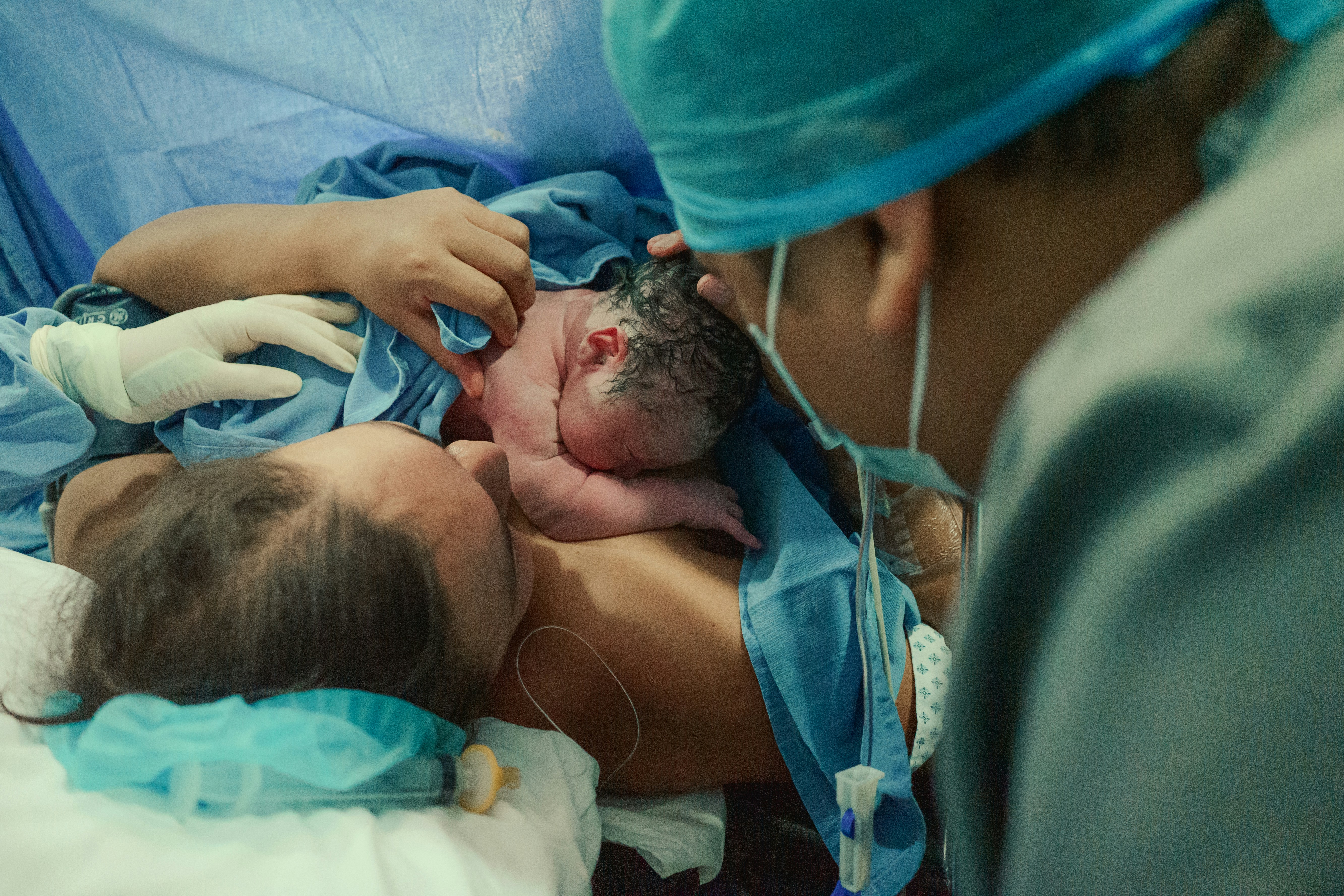
The very first thing they understand isn't your words, it's your touch. When you place your baby on your bare chest, something ancient and beautiful happens. They feel your warmth. They hear that familiar heartbeat. And their tiny, overwhelmed brain gets the message: [1]
"Oh. I know this place. I am safe. I am not alone."
"Skin-to-skin contact is not a 'nice to have' it is a biological necessity. The newborn's brain is expecting to be on the mother's chest. That's where it finishes developing."
2. The "Love Hormone" Rush: It's Real!
You've probably heard of "mother's intuition" or that instant rush of love people talk about. Maybe you've felt it that overwhelming wave of "I would die for this tiny human" that hits you when they're in your arms.
Well, there's a chemical for that. It's called oxytocin, and it's often called the "love hormone" or the "cuddle chemical." But here's the thing it's not just a feeling. It's biology doing its magic. [3]
What this magical hormone does:
- For your baby: It lowers their stress hormones (like cortisol) and floods them with feelings of calm and safety. Their little body literally relaxes into yours.
- For you (mama or dada): It strengthens that overwhelming feeling of bonding. It helps you feel more connected, more confident, more like "I can actually do this." [4]
- For both of you: Research shows that when a calm parent holds their baby, both of their hearts can begin to beat in a similar, relaxed rhythm. [5] You're literally falling into step with each other.
A comprehensive systematic review published in the International Journal of Nursing Sciences found that oxytocin levels significantly increase in infants, mothers, and fathers during skin-to-skin contact [6]. Parents with higher oxytocin levels were observed to exhibit more synchrony and responsiveness in their interactions with their babies. This suggests that the bonding hormone doesn't just create a feeling it actively shapes how parents and babies connect with each other.
A quiet moment for you
- Think back to the first time you held your baby. What did you feel in that moment?
- When do you feel most connected to them morning, night, after a feed?
- What would it feel like to carve out just 15 minutes today for nothing but cuddles?
3. Your Chest is the Best Baby Monitor
Hospitals have all sorts of high-tech machines to check a baby's vitals. Beeping screens. Wires. Monitors that track every breath.
But guess what works better than most of them? Your chest. [7]
When a baby is placed on a parent's chest, something almost magical happens. Their tiny body starts to regulate itself. Doctors call it "kangaroo care," and it's especially powerful for premature babies: [8]
- A steady heartbeat: Their heart rate becomes more stable, less erratic. Research shows that preterm infants who receive skin-to-skin contact demonstrate better cardiorespiratory stability [9].
- Easier breathing: They fall into a more regular breathing pattern no more gasps or pauses.
- Perfect temperature: Your body automatically adjusts its temperature to keep your baby perfectly warm. [7]
For a tiny human trying to figure out how to live in this big world, your body is the ultimate life-support system. No batteries required.
The World Health Organization's clinical practice guide for Kangaroo Mother Care emphasizes that prolonged skin-to-skin contact and breastfeeding together form a powerful intervention that improves breastfeeding rates, survival, and reduces complications such as serious infections [10]. The evidence is so strong that WHO now recommends KMC be provided for all preterm or low birthweight infants, beginning immediately after birth.
4. Building Your Baby's Brain, One Cuddle at a Time
Did you know that in the first two years, your baby's brain is absolutely on fire? It's making over one million new neural connections every single second.
Every gentle touch. Every hug. Every time you hold them close while they sleep you are literally building the architecture of their brain. Research suggests that babies who have frequent skin-to-skin time show better brain development, higher cognitive function, and improved emotional regulation as they grow. [11] You're stimulating the parts that will one day help them:
- Trust their friends and partners.
- Feel secure in new situations.
- Show kindness and empathy to others.
- Stay calm when things get tough.
A groundbreaking study published in Neurology, the medical journal of the American Academy of Neurology, found that skin-to-skin contact in preterm infants was linked to measurable differences in brain development, particularly in regions tied to emotional and stress regulation [12]. Longer cuddle sessions were associated with signs of brain growth in the cingulum which supports attention and emotion regulation and the anterior thalamic radiations, which connect areas involved in emotional processing and memory. Even after adjusting for medical and social factors like gestational age and socioeconomic status, these brain differences remained significant.
Lead author Dr. Katherine Travis of Burke Neurological Institute put it beautifully: "We're just starting to understand why a very natural thing skin-to-skin contact is so powerful. It's not just about medicine and an incubator in the NICU; mom and dad are a powerful medicine for brain development." [12]
If you're curious about how this early bonding connects to lifelong emotional patterns, you might want to explore Internal Working Model: How Early Attachment Shapes Every Relationship it explains why those early cuddles matter so much.
5. Giving Breastfeeding a Helping Hand
For moms who choose to breastfeed, skin-to-skin is like a secret weapon you didn't know you had. Doing skin-to-skin with your baby can help bring your milk supply in and support breastfeeding. [4]
Right after birth, if you place your baby on your chest, they will often do something incredible. They will instinctively start to wiggle and crawl their way toward your breast. It's called the "breast crawl," and research shows that newborn infants have an increased sensitivity for the smell of breastmilk, especially soon after birth indicating a biologically-based early sensitive period. [13]
A Cochrane systematic review that included 69 trials and over 7,200 mother-infant pairs found that skin-to-skin contact probably increases rates of exclusive breastfeeding at hospital discharge and at six weeks to six months postbirth [13]. The review concluded that immediate or early skin-to-skin contact after birth supports the establishment of breastfeeding and improves neonatal physiological outcomes.

6. Dads and Partners: This is For You Too!
Stop right there if you think this is just a "mom and baby" thing. It's not. It's a "parent and baby" thing. Full stop. [14]
When dads or other caregivers hold the baby skin-to-skin, amazing things happen for them too. Their oxytocin levels go up! [3] Research shows that fathers who provide skin-to-skin contact report feeling more connected and confident in caring for their babies. [15]
- Feel a stronger, more immediate emotional connection.
- Gain confidence in their ability to soothe and care for the baby.
- Lower their own stress and anxiety yes, partners get overwhelmed too.
The baby also learns to recognize your unique heartbeat, your smell, your voice. This builds a wider circle of safety and love, showing the baby they are cared for by a whole team, not just one person. [16]
A study published in the Journal of Perinatal Medicine found that early kangaroo care initiated within the first 24 hours after birth significantly reduced mortality risk in very preterm and very low birth weight infants [17]. The study, which included 1,679 newborns, showed a 19% reduction in mortality risk with early kangaroo care, highlighting how this simple practice can be life-saving for the most vulnerable babies.

7. The "Fussy Baby" Antidote
Ever feel like your baby just won't stop crying and nothing you do works? You've fed them. Changed them. Rocked them. Sung to them. And still screaming.
Before you try anything else, before you spiral into "what's wrong with my baby" or "what's wrong with me," try this: skin-to-skin cuddle.
A systematic review and meta-analysis published in the Jornal de Pediatria found that skin-to-skin contact significantly reduced procedural pain in neonates compared to standard care and swaddling [18]. The review, which included 29 randomized controlled trials involving nearly 3,000 newborns, found that skin-to-skin contact was not only effective for calming babies but also for reducing pain during procedures like heel pricks or needle sticks. Your chest truly is the most comforting place your baby can be.
8. A Glimpse Into What Happens Without Touch
It's a sad truth, but we learn a lot about the importance of touch by studying what happens when it's missing.
Studies of babies in institutions who didn't get enough physical affection showed significant delays in their emotional and cognitive growth. They were fed. They were kept clean. But without touch, they struggled to thrive. The Cochrane research review confirms that skin-to-skin contact helps babies adapt to life outside the womb, keeping them warm, reducing stress and crying, and supporting vital functions such as breathing and heart rate. [7]
A meta-analysis published in Advances in Neonatal Care found that kangaroo care significantly improved the weight, head circumference, and body length of preterm infants, with positive effects on neurodevelopmental and brain growth indicators [19]. The researchers noted that clinically, nurses can support parents in initiating and maintaining kangaroo care, helping to enhance parental involvement during the NICU stay.
A Letter From Your Future Self
Hey... it's you. One year from now.
I know you're tired. I know you're worried you're not enough. I know you replay every moment you couldn't soothe the crying, every time you weren't sure what to do.
But let me tell you something you can't see yet: every single time you held your baby close even when you were exhausted, even when you felt like you were failing you were building something unbreakable.
That baby? They don't remember the messy house or the takeout dinners. They don't remember the nights you cried from exhaustion. What they remember what their nervous system knows is your warmth. Your heartbeat. The way you showed up, again and again.
You're going to blink, and they'll be walking. You'll blink again, and they'll be saying your name. And in that moment, you'll understand: you didn't need to be perfect. You just needed to be there.
And you were. You are. Keep going. I'm so proud of you.
9. Making Skin-to-Skin Part of Your Everyday
You don't need a special class or any equipment. You don't need to wait for the "perfect moment." You just need you, your baby, and a few quiet minutes.
Simple ways to weave it in:
- After a warm bath: When you're both relaxed and warm.
- During a quiet afternoon nap: On the couch (while you stay awake to supervise).
- When they're fussy: Before you try anything else.
- After a feeding: To help them drift off peacefully.
- First thing in the morning: Before the day gets busy.
Even just 15 or 20 minutes a day can make a world of difference. It's about quality, consistency, and connection not perfection.
Research suggests that even 15–20 minutes of skin-to-skin contact on a daily basis may serve an important developmental purpose and help circumvent barriers to early childhood caregiving [20]. The benefits of this practice can extend well beyond the newborn period, supporting improved maternal-child bonding and secure attachment throughout the first year of life.
Understanding your baby's unique temperament can make cuddle time even more intuitive. Learn more in Understanding Infant Temperament: A Framework for Parents it's a gentle guide to your baby's natural rhythm.
10. It All Comes Back to This
The newborn phase is a blur of diapers, feeding, and sleepless nights. You'll forget a lot of it the exact timing of feeds, the color of that onesie, the words to that lullaby.
But right in the middle of that beautiful chaos, something profound is happening. Every time you scoop up your little one and hold them close, you're not just comforting them for the moment.
You are whispering a message that will echo throughout their entire life:
"You are loved. You are safe. You belong here."
Before you go...
How did this article make you feel? Your small reaction helps this space grow with more meaningful stories. 💛
What does skin-to-skin feel like for you?
Anonymous · Just you and the universe
About this article: This educational guide was written by Shobini Padmanapan, an independent wellness writer and editorial researcher at SoulSpace. It synthesizes publicly available research on skin-to-skin contact, kangaroo care, and early infant bonding.
Scope: Educational and informational only. Not clinical advice, diagnosis, or treatment.
Author profile: soulspaceguide.com/authors/shobini-padmanapan
Answers to Questions You Might Be Too Tired to Ask
Absolutely not! While it's wonderful to start early, the benefits of cuddling and touch continue throughout infancy. Your baby will always benefit from feeling safe and connected to you. Even toddlers benefit from calm, connected cuddle time. It's never, ever too late. [8]
Yes, you can! With the help of medical team members, families are able to enjoy skin-to-skin time even with tubes and machines. Many hospitals now offer C-section skin-to-skin. [21]
It's wonderful! It means they feel completely safe and relaxed. Just make sure you stay awake to supervise. Skin-to-skin is for cozy, awake bonding time if you feel sleepy yourself, gently move baby to their own safe sleep space like a bassinet. Safe cuddles are happy cuddles.
That can happen! Try different times of day when they're calm and content, not hungry or overtired. You can also try walking around gently while holding them, or softly singing. A warm room helps too. Some babies just need a minute to settle into the cozy give them that minute.
Even 15-20 minutes makes a difference! There's no minimum or maximum follow your baby's cues. Some babies want an hour. Some want 10 minutes and then they're done. You're not doing it wrong if it's short. You're just listening to your baby.
Found this helpful? Share it with someone who needs it.
Written by Shobini Padmanapan · SoulSpace
How do you feel now?
You are enough.
In the middle of all the advice, all the worry, all the "shoulds" remember this. Your arms are home. Your heartbeat is lullaby. Your touch is medicine.
Tonight, when you hold your baby, notice the moment they relax into you. That sigh. That tiny hand unfurling. That's not just comfort. That's trust. That's connection. That's the foundation of a human being, being built right there in your arms.
And you're the one building it.
Your Skin-to-Skin Cheat Sheet
- 15 minutes is all it takes to lower stress hormones
- Your chest regulates baby's temperature, heartbeat, and breathing
- Oxytocin floods both of you it's the "love hormone" at work
- Dads & partners benefit too this is for everyone
- Never too late even toddlers benefit from calm cuddle time
References & Further Reading
- Widström, A. M., Brimdyr, K., Svensson, K., Cadwell, K., & Nissen, E. (2019). Skin-to-skin contact the first hour after birth, underlying implications and clinical practice. Pediatric Medicine. PMC6949952
- World Health Organization. (2025). Kangaroo mother care: A clinical practice guide. who.int
- Cong, X., Young, E. E., Robinson, J. A., McGrath, J. M., Vittner, D., Eisenfeld, L., Lawhon, G., & Cusson, R. M. (2017). Increase in oxytocin from skin-to-skin contact enhances development of parent-infant relationship. Biological Research for Nursing, 20(1). doi.org/10.1177/1099800417735633
- Parkinson, M. (2025, October 22). Strong evidence supports skin-to-skin contact after birth as standard care. Cochrane.org. cochrane.org
- Cleveland Clinic. (2025, July 15). Kangaroo care (skin-to-skin contact). Cleveland Clinic Health Library. my.clevelandclinic.org
- Scatliffe, N., Casavant, S., Vittner, D., & Cong, X. (2019). Oxytocin and early parent-infant interactions: A systematic review. International Journal of Nursing Sciences, 6(4), 445-453. doi.org/10.1016/j.ijnss.2019.09.009
- Moore, E. R., Brimdyr, K., Blair, A., Jonas, W., Lilliesköld, S., Svensson, K., Ahmed, A. H., Bastarache, L. R., Crenshaw, J. T., Giugliani, E. R. J., Grady, J. E., Zakarija-Grkovic, I., Haider, R., Hill, R. R., Kagawa, M. N., Mbalinda, S. N., Stevens, J., Takahashi, Y., & Cadwell, K. (2025). Immediate or early skin-to-skin contact for mothers and their healthy newborn infants. Cochrane Database of Systematic Reviews, 10(10), CD003519. doi.org/10.1002/14651858.CD003519.pub5
- La Leche League International. Skin-to-skin contact. LLLI.org. llli.org
- Albzea, W., et al. (2025). The thermoregulatory effect of immediate skin-to-skin contact for preterm infants: A systematic review and meta-analysis with trial sequential analysis. Cureus, 17(8), e90454. doi.org/10.7759/cureus.90454
- Stanford Global Health. (2025, December 4). New WHO resource offers guidance for Kangaroo Mother Care. globalhealth.stanford.edu
- Stephan, T. (2025, March 11). The science of skin-to-skin: How touch shapes your baby's developing brain. Gentle Beginnings Doula. gentle-beginnings-doula.com
- Travis, K. E., et al. (2025). Skin-to-skin contact associated with brain changes in preterm infants. Neurology. American Academy of Neurology. aan.com
- Moore, E. R., et al. (2025). Immediate or early skin-to-skin contact for mothers and their healthy newborn infants. Cochrane Database of Systematic Reviews, 10(10), CD003519. doi.org/10.1002/14651858.CD003519.pub5
- WaterWipes. The science behind skin-to-skin contact. WaterWipes Skincare Hub. waterwipes.com
- Yurdal, N. E. Ö., & Özsoy, S. (2025). Fathers' skin-to-skin contact practices with their babies. Scientific Reports. nature.com
- Heloa. (2025, May 15). Skin-to-skin contact benefits for both parents and baby. Heloa.app. heloa.app
- Martins, J. A., Ferreira-da-Silva, R., Assunção, A., Clemente, F., Azevedo, I., & Costa, S. (2026). Early kangaroo care in preterm ≤32 weeks and very low birth weight infants: A systematic review and meta-analysis. Journal of Perinatal Medicine, 54(4), 799. doi.org/10.1515/jpm-2025-0202
- Impact of skin-to-skin contact on acute procedural pain in newborns: A systematic review and meta-analysis. (2025). Jornal de Pediatria, 101(6). doi.org/10.1016/j.jped.2025.101442
- Han, Z., Li, X., Hu, F., & Yang, J. (2025). Meta-analysis of the impact of kangaroo care on physical growth and neurobehavioral development in premature infants. Advances in Neonatal Care, 25(2), 162-172. doi.org/10.1097/ANC.0000000000001254
- Extended kangaroo mother care – Examining the utility of skin-to-skin contact over the first year of life. (2025). ScienceDirect. sciencedirect.com
- Weinstock, J. (2025, April 25). Skin-to-skin contact offers key benefits for parent and child. Children's Hospital Los Angeles. chla.org
Continue your gentle journey
Curated by Shobini Padmanapan
Be the first to share your thoughts anonymously or with a name.